
Do you need a wealth manager if you can manage your own investments?
17th July 2026
We hear this a lot. Someone tells us, often within the first five minutes of a conversation, that they could manage their own money. And in most cases, they are right. Many of our clients are sharp, numerate, successful people. Running spreadsheets and reading a fund factsheet is not beyond them.
The question is not whether they are capable. The question is whether managing their own portfolio is the best use of their time, and whether doing it alone actually produces the outcome they think it does.
The question is not whether they are capable. The question is whether managing their own portfolio is the best use of their time, and whether doing it alone actually produces the outcome they think it does.
Why capability was never the real question
If you sat down every client relationship we have and separated them into two groups, the picture would not match the usual assumption. A small minority genuinely feel out of their depth with investing and want someone else to hold that responsibility entirely. The much larger group is different. They are entirely capable of managing a portfolio (performance notwithstanding). They have chosen not to, because their time is better spent running their business, practising their profession, or doing the things that actually justify the hours in their week.
If you sat down every client relationship we have and separated them into two groups, the picture would not match the usual assumption. A small minority genuinely feel out of their depth with investing and want someone else to hold that responsibility entirely. The much larger group is different. They are entirely capable of managing a portfolio (performance notwithstanding). They have chosen not to, because their time is better spent running their business, practising their profession, or doing the things that actually justify the hours in their week.

That distinction changes the conversation entirely. This is not a competence question. It is a resource allocation question, and for most business owners and senior professionals, time is the scarcest resource they have.
The maths on your own hours
UK research published in 2026 found the average business owner works close to 50 hours a week, with time split across sales, administration, finance, and strategy, and strategy consistently receiving the least attention of any category despite being the highest-value use of an owner's time. Every hour spent reviewing a portfolio, researching a fund, or worrying about a market headline is an hour not spent on the business generating the income in the first place.
There is also a well-documented reason people default to doing it themselves anyway, and it is rarely about the numbers. Research into UK business owners' habits found a majority prefer to handle everything personally, and when asked why, the most common reason given was a belief that they were simply the most capable option available to them. That belief is often true of the business. It is not automatically true of a diversified international portfolio, tax-efficient pension structuring, or currency risk across two or three jurisdictions, which is a different skill set entirely.
The maths on your own hours
UK research published in 2026 found the average business owner works close to 50 hours a week, with time split across sales, administration, finance, and strategy, and strategy consistently receiving the least attention of any category despite being the highest-value use of an owner's time. Every hour spent reviewing a portfolio, researching a fund, or worrying about a market headline is an hour not spent on the business generating the income in the first place.
There is also a well-documented reason people default to doing it themselves anyway, and it is rarely about the numbers. Research into UK business owners' habits found a majority prefer to handle everything personally, and when asked why, the most common reason given was a belief that they were simply the most capable option available to them. That belief is often true of the business. It is not automatically true of a diversified international portfolio, tax-efficient pension structuring, or currency risk across two or three jurisdictions, which is a different skill set entirely.

The part self-managed investors consistently get wrong
Even for those who are genuinely capable of managing a portfolio, the data on self-directed investment performance tells a consistent story. It is not a story about intelligence. It is a story about behaviour.
DALBAR has tracked the gap between what the market returns and what the average investor actually earns for over three decades. Over the twenty years to the end of 2024, the average equity investor earned 9.24% a year, against 10.35% a year for the S&P 500 itself. In 2024 alone, a strong year for markets, the average investor captured 16.54% while the index returned 25.02%, a shortfall of nearly 850 basis points in a single year.
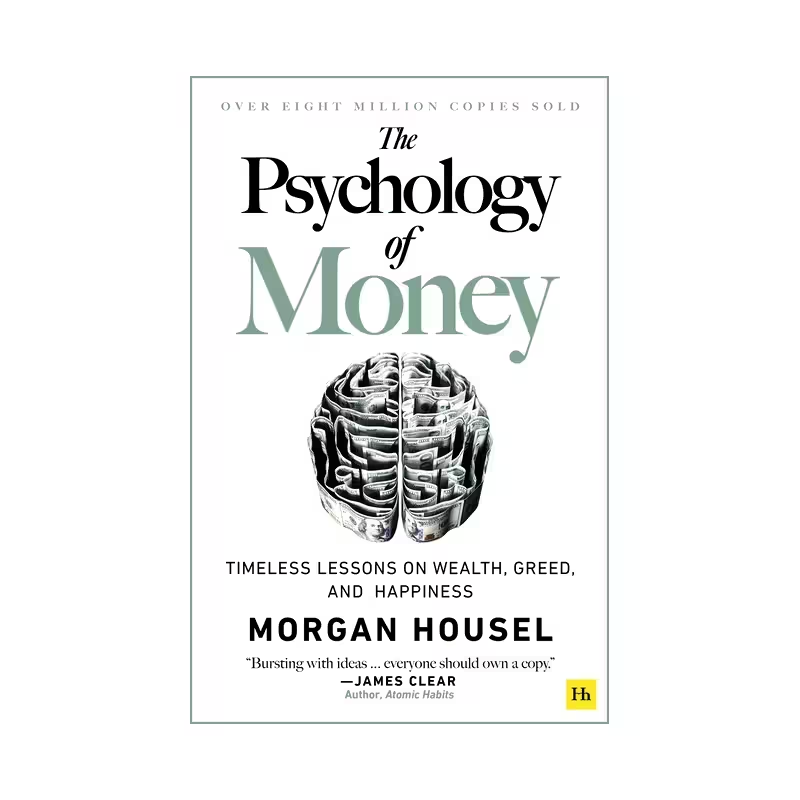
That gap is not explained by fees or fund selection. It is explained by timing. Selling after a fall. Buying after a rally. Holding cash on the sidelines waiting for a better entry point that rarely arrives on schedule. Morgan Housel's central argument in The Psychology of Money is that investing success has very little to do with what you know and almost everything to do with how you behave under pressure, and the DALBAR numbers back that up year after year. The average holding period for an equity fund has fallen below five years, roughly half the length of a typical market cycle, which means most self-directed investors are exiting positions before the strategy they chose has had time to work.
Compounded over twenty or thirty years, a gap of even one percentage point a year is not a rounding error. It is the difference between retiring comfortably and running short.
What the DIY conversation always leaves out
Even where someone could match the market's return through sheer discipline, "managing my own investments" usually means exactly that and nothing more. It rarely extends to the parts of a financial plan that do not show up on a trading app.
Proper allocation across asset classes and geographies, rather than concentration in whatever has performed well recently. Structured protection against the risks that would actually derail a plan, not just market volatility. Succession and estate planning that accounts for cross-border rules, since a will written for one jurisdiction does not automatically work in another. Cashflow modelling that tells you whether your current plan actually gets you to the retirement you want, rather than assuming it will.
Tax-efficient structuring across two or three jurisdictions at once, which is rarely a DIY exercise once more than one country's rules are involved.
None of that is a product to be bought once and forgotten. It is a process that needs revisiting as life changes, and it is the part of the conversation that gets skipped entirely when the question is framed as "could I pick my own funds."
Even for those who are genuinely capable of managing a portfolio, the data on self-directed investment performance tells a consistent story. It is not a story about intelligence. It is a story about behaviour.
DALBAR has tracked the gap between what the market returns and what the average investor actually earns for over three decades. Over the twenty years to the end of 2024, the average equity investor earned 9.24% a year, against 10.35% a year for the S&P 500 itself. In 2024 alone, a strong year for markets, the average investor captured 16.54% while the index returned 25.02%, a shortfall of nearly 850 basis points in a single year.
That gap is not explained by fees or fund selection. It is explained by timing. Selling after a fall. Buying after a rally. Holding cash on the sidelines waiting for a better entry point that rarely arrives on schedule. Morgan Housel's central argument in The Psychology of Money is that investing success has very little to do with what you know and almost everything to do with how you behave under pressure, and the DALBAR numbers back that up year after year. The average holding period for an equity fund has fallen below five years, roughly half the length of a typical market cycle, which means most self-directed investors are exiting positions before the strategy they chose has had time to work.
Compounded over twenty or thirty years, a gap of even one percentage point a year is not a rounding error. It is the difference between retiring comfortably and running short.
What the DIY conversation always leaves out
Even where someone could match the market's return through sheer discipline, "managing my own investments" usually means exactly that and nothing more. It rarely extends to the parts of a financial plan that do not show up on a trading app.
Proper allocation across asset classes and geographies, rather than concentration in whatever has performed well recently. Structured protection against the risks that would actually derail a plan, not just market volatility. Succession and estate planning that accounts for cross-border rules, since a will written for one jurisdiction does not automatically work in another. Cashflow modelling that tells you whether your current plan actually gets you to the retirement you want, rather than assuming it will.
Tax-efficient structuring across two or three jurisdictions at once, which is rarely a DIY exercise once more than one country's rules are involved.
None of that is a product to be bought once and forgotten. It is a process that needs revisiting as life changes, and it is the part of the conversation that gets skipped entirely when the question is framed as "could I pick my own funds."
The actual decision
Being capable of managing your own money is not the same question as whether it is the highest-value use of your time, or whether doing it alone protects you from the behavioural mistakes that quietly erode returns for even sophisticated investors. For most of the people we work with, the answer is straightforward once it is framed properly. They would rather spend fifty hours a week on the business they built, and hand the portfolio, the planning, and the behavioural discipline to someone whose full-time job is exactly that.
You can book an initial call below.
Being capable of managing your own money is not the same question as whether it is the highest-value use of your time, or whether doing it alone protects you from the behavioural mistakes that quietly erode returns for even sophisticated investors. For most of the people we work with, the answer is straightforward once it is framed properly. They would rather spend fifty hours a week on the business they built, and hand the portfolio, the planning, and the behavioural discipline to someone whose full-time job is exactly that.
You can book an initial call below.
