
The loan note problem
15th May 2026
There are products circulating in the international financial advice market that should, in most cases, never find their way into the portfolios of ordinary investors. Loan notes are among them.
This is not a new observation. The risks have been discussed in professional circles for years. But they keep appearing, pitched by international advisers to expatriate clients who often have no particular reason to be suspicious, and who trust that the person sitting across from them has their interests at heart.
They frequently do not.
This is not a new observation. The risks have been discussed in professional circles for years. But they keep appearing, pitched by international advisers to expatriate clients who often have no particular reason to be suspicious, and who trust that the person sitting across from them has their interests at heart.
They frequently do not.
Over the past twelve months, a number of loan note structures have collapsed with catastrophic consequences for the people who invested in them. One of the more significant examples involved a UK-based property developer whose fundraising arm raised over £160 million from more than 2,500 individual investors, many of them British expats based across the Middle East and elsewhere, through a network of introducers and international financial advisory firms.
What was sold as a safe, asset-backed investment is shaping up to be one of the largest collective losses suffered by retail investors in modern British history, with a potential shortfall in the region of £157 million.
Investors were promised fixed-interest returns of between 8% and 12%, with their money supposedly secured against UK property assets and repayable after two years. Administrators have since found that rather than being used to buy and build assets, the notes were used to repay other investors and fund working capital.
The national average pay-out following administration sits at somewhere between two and four pence in the pound, with the vast majority of creditors receiving nothing.
For the advisers who sold these products, the picture looks rather different. Salespeople were incentivised with outsized commissions, and in at least one documented case, rewards including holidays and the chance to drive supercars. Those incentives did not appear in the documentation handed to investors.
This is not an isolated story. A second recent collapse followed a broadly similar pattern: a sophisticated-sounding product, double-digit return promises, supposedly secured assets, and ultimately, investors left with very little. We are not naming every firm in this post. The point is not to compile a list. The point is to explain how this keeps happening, and why.
What was sold as a safe, asset-backed investment is shaping up to be one of the largest collective losses suffered by retail investors in modern British history, with a potential shortfall in the region of £157 million.
Investors were promised fixed-interest returns of between 8% and 12%, with their money supposedly secured against UK property assets and repayable after two years. Administrators have since found that rather than being used to buy and build assets, the notes were used to repay other investors and fund working capital.
The national average pay-out following administration sits at somewhere between two and four pence in the pound, with the vast majority of creditors receiving nothing.
For the advisers who sold these products, the picture looks rather different. Salespeople were incentivised with outsized commissions, and in at least one documented case, rewards including holidays and the chance to drive supercars. Those incentives did not appear in the documentation handed to investors.
This is not an isolated story. A second recent collapse followed a broadly similar pattern: a sophisticated-sounding product, double-digit return promises, supposedly secured assets, and ultimately, investors left with very little. We are not naming every firm in this post. The point is not to compile a list. The point is to explain how this keeps happening, and why.

What a loan note actually is
A loan note is, in simple terms, an agreement to lend money to a company or individual in return for interest payments and the eventual return of capital. They are not inherently fraudulent instruments. In certain contexts, private equity for example, or professional investor allocations, they serve a legitimate purpose.
The problem arises when they are packaged and sold as investment products to ordinary retail investors, often expats with a savings pot and a desire to do something sensible with it. At that point, a number of structural issues emerge.
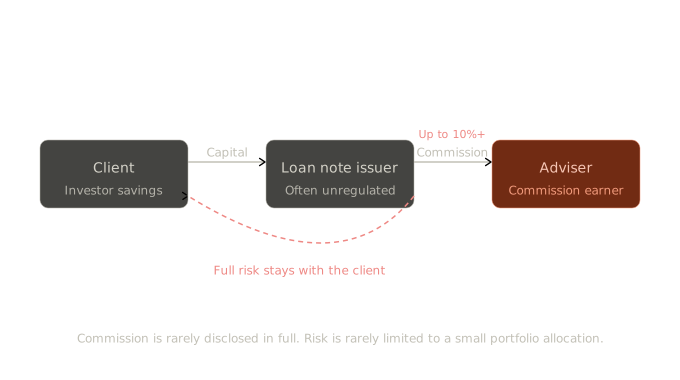
First, loan notes are not regulated in the same way as most investment products. They sit outside the protections that govern a regulated fund or pension investment. If the issuing company fails, the investor is an unsecured creditor, which in practice means they join a queue that typically moves very slowly and pays out very little.
Second, they are illiquid. Unlike a fund or listed investment, there is generally no secondary market. Once you have committed your capital, it is committed. If you need the money back before the term ends, or if the issuer starts to struggle, your options are extremely limited.
Third, and this is the part that most concerns us, they pay significant commissions to the people who sell them. In some cases, 10% or more of the capital invested goes directly to the adviser or introducer. That is before any charges, management fees or costs within the product itself. The investor often has no idea this arrangement exists.
The incentive structure is not difficult to understand. A product that pays 10% commission to the person recommending it will always attract a certain type of salesperson. And in international markets, where regulation is lighter and client protections are thinner, that type tends to thrive.
Why expats are particularly exposed
Living overseas creates genuine financial complexity. Tax residency, pension obligations, foreign income, cross-border estate planning: there are real reasons why expatriates need qualified financial advice, and there are not always obvious places to find it.
Into that gap steps a large and varied cast of international financial advisers. Some are excellent. Many are mediocre. And a meaningful number have no real interest in client outcomes at all. They are commission farmers operating in markets where the rules are light enough to allow it.
Expats in Asia and the Middle East have historically been sold products that would not pass basic scrutiny in the UK. Loan notes are part of that picture. So are certain offshore bonds, high-charging structured products, and funds that levy two percent a year while quietly returning a portion of that to the adviser, undisclosed.
We still receive enquiries from loan note distributors. They arrive with cheerful brochures and impressive-sounding underlying themes: litigation funding, rare wine, renewable energy in sub-Saharan Africa, agricultural land, private credit. Some of these are legitimate investment categories in other contexts. As retail loan notes targeted at expatriate savers, they are not something we would ever recommend.
The answer is always the same: thank you, but no. It falls entirely outside our risk framework as a firm.
More directly, and we will be candid here, we think these products cause serious harm when distributed without transparency. And they almost always are.
A loan note is, in simple terms, an agreement to lend money to a company or individual in return for interest payments and the eventual return of capital. They are not inherently fraudulent instruments. In certain contexts, private equity for example, or professional investor allocations, they serve a legitimate purpose.
The problem arises when they are packaged and sold as investment products to ordinary retail investors, often expats with a savings pot and a desire to do something sensible with it. At that point, a number of structural issues emerge.
First, loan notes are not regulated in the same way as most investment products. They sit outside the protections that govern a regulated fund or pension investment. If the issuing company fails, the investor is an unsecured creditor, which in practice means they join a queue that typically moves very slowly and pays out very little.
Second, they are illiquid. Unlike a fund or listed investment, there is generally no secondary market. Once you have committed your capital, it is committed. If you need the money back before the term ends, or if the issuer starts to struggle, your options are extremely limited.
Third, and this is the part that most concerns us, they pay significant commissions to the people who sell them. In some cases, 10% or more of the capital invested goes directly to the adviser or introducer. That is before any charges, management fees or costs within the product itself. The investor often has no idea this arrangement exists.
The incentive structure is not difficult to understand. A product that pays 10% commission to the person recommending it will always attract a certain type of salesperson. And in international markets, where regulation is lighter and client protections are thinner, that type tends to thrive.
Why expats are particularly exposed
Living overseas creates genuine financial complexity. Tax residency, pension obligations, foreign income, cross-border estate planning: there are real reasons why expatriates need qualified financial advice, and there are not always obvious places to find it.
Into that gap steps a large and varied cast of international financial advisers. Some are excellent. Many are mediocre. And a meaningful number have no real interest in client outcomes at all. They are commission farmers operating in markets where the rules are light enough to allow it.
Expats in Asia and the Middle East have historically been sold products that would not pass basic scrutiny in the UK. Loan notes are part of that picture. So are certain offshore bonds, high-charging structured products, and funds that levy two percent a year while quietly returning a portion of that to the adviser, undisclosed.
We still receive enquiries from loan note distributors. They arrive with cheerful brochures and impressive-sounding underlying themes: litigation funding, rare wine, renewable energy in sub-Saharan Africa, agricultural land, private credit. Some of these are legitimate investment categories in other contexts. As retail loan notes targeted at expatriate savers, they are not something we would ever recommend.
The answer is always the same: thank you, but no. It falls entirely outside our risk framework as a firm.
More directly, and we will be candid here, we think these products cause serious harm when distributed without transparency. And they almost always are.
The damage to trust
We have more conversations than we would like with prospective clients who are deeply sceptical of the entire international advice profession. They have either lost money directly through these products, know someone who has, or have simply done enough reading to be wary. That scepticism is, in many cases, entirely justified.
The difficulty is that it paints everyone with the same brush. A client who has been burned by a commission-driven salesperson pushing an opaque loan note structure has every reason to approach the next adviser with suspicion, even if that adviser operates in a completely different way.
Rebuilding that trust takes time. It means being transparent about how we charge, what we hold, why we hold it, and what every element of a client's portfolio costs. It means evidence over promises and structured portfolios over exciting products. And it means being willing to have the occasionally uncomfortable conversation about what good advice actually looks like, and what it does not.
How to protect yourself: what to ask before taking any financial advice overseas
Given how frequently these conversations come up, we have put together a set of principles we think every expatriate investor should apply before engaging with a financial adviser in any international market. We will include these across our content regularly, because they matter.
The Brigantia checklist for choosing an international adviser
We have more conversations than we would like with prospective clients who are deeply sceptical of the entire international advice profession. They have either lost money directly through these products, know someone who has, or have simply done enough reading to be wary. That scepticism is, in many cases, entirely justified.
The difficulty is that it paints everyone with the same brush. A client who has been burned by a commission-driven salesperson pushing an opaque loan note structure has every reason to approach the next adviser with suspicion, even if that adviser operates in a completely different way.
Rebuilding that trust takes time. It means being transparent about how we charge, what we hold, why we hold it, and what every element of a client's portfolio costs. It means evidence over promises and structured portfolios over exciting products. And it means being willing to have the occasionally uncomfortable conversation about what good advice actually looks like, and what it does not.
How to protect yourself: what to ask before taking any financial advice overseas
Given how frequently these conversations come up, we have put together a set of principles we think every expatriate investor should apply before engaging with a financial adviser in any international market. We will include these across our content regularly, because they matter.
The Brigantia checklist for choosing an international adviser
- Demand full disclosure of all earnings. Before you sign anything, ask the adviser to put in writing every fee, commission, rebate, kickback or other form of remuneration they will receive in connection with any recommendation they make. If they are reluctant to do this, that reluctance tells you something important.
- Interrogate every layer of charges. A "fee-based" adviser can still place clients in funds that levy two percent per year and return one percent of that to the adviser, often without clear disclosure. Ask for a full cost breakdown of every product suggested, including the total expense ratio, any adviser remuneration embedded within the product, and any platform or wrapper charges.
- Look for experience in a well-regulated jurisdiction. Advisers who have worked within the UK regulatory framework, and particularly those who trained and qualified there, tend to operate to a higher standard. That experience matters.
- Check that they hold a recognised qualification. A minimum of Level 4 qualification from an institution such as the Chartered Insurance Institute (CII) or the Chartered Institute for Securities and Investment (CISI) is a reasonable baseline. Anything less should prompt further questions.
- Verify that they are regulated somewhere. International regulation is rarely as robust as the UK's Financial Conduct Authority, but some oversight is better than none. Ask which regulator governs their advice activities and what that regulation actually covers.
- Understand where they sit within a wider structure. Advisers who operate as part of a larger group or network, with compliance oversight, regular reviews and a clear escalation structure, are generally more accountable than those operating entirely independently. Ask who oversees their advice and how.
- Watch the conversation carefully. If an adviser moves quickly towards complex products, particularly anything involving private credit, or illiquid alternatives, early in a relationship and before they have understood your full financial situation, that is a warning sign. A good adviser spends the majority of early conversations asking questions and listening, not recommending.
- Check for lock-ins and restrictions. Before committing to anything, understand fully how and when you can access your money. Are there early exit penalties? Fixed terms? Conditions attached to interest payments? These details matter enormously and are sometimes buried in documentation that is easy to overlook.
- Always ask: what is the worst case here? Not the best case. Not the projected return. The worst case. If the issuer fails, if the market moves against you, if you need the money back early, what happens? If you cannot get a clear and satisfactory answer to that question, do not proceed.
- Read their content before you trust their advice. Look at their blog posts, social media, client communications. Are they focused on client outcomes, financial planning principles, long-term thinking? Or is the content shallow, product-heavy, or conspicuously absent? An adviser's published views tend to reflect their actual priorities.

Why we do things differently
Brigantia operates on a transparent, fee-based model. We do not have a financial incentive to recommend one product over another, because we are paid by our clients and not by the firms whose products we might use.
The portfolios we build are diversified, evidence-based and matched to each client's individual circumstances and risk tolerance. We do not use loan notes. We do not accept distribution fees disguised as something else.
We are not trying to be sanctimonious about this. There are firms in the international market doing decent work. But there are also a lot doing the opposite, and the consequences for the people on the receiving end can be severe.
The recent product collapses did not happen because investors were careless. It happened because the incentives within an unregulated distribution network were entirely misaligned with client outcomes, and nobody with the authority to intervene did so until it was too late.
That is exactly the kind of outcome our model is designed to prevent.
If you have concerns about existing investments, or want to understand what proper advice looks like, we are happy to talk.
Brigantia operates on a transparent, fee-based model. We do not have a financial incentive to recommend one product over another, because we are paid by our clients and not by the firms whose products we might use.
The portfolios we build are diversified, evidence-based and matched to each client's individual circumstances and risk tolerance. We do not use loan notes. We do not accept distribution fees disguised as something else.
We are not trying to be sanctimonious about this. There are firms in the international market doing decent work. But there are also a lot doing the opposite, and the consequences for the people on the receiving end can be severe.
The recent product collapses did not happen because investors were careless. It happened because the incentives within an unregulated distribution network were entirely misaligned with client outcomes, and nobody with the authority to intervene did so until it was too late.
That is exactly the kind of outcome our model is designed to prevent.
If you have concerns about existing investments, or want to understand what proper advice looks like, we are happy to talk.
